De Minimis Benefits in 2026: Tax-Free Perks You Can Give
What are de minimis benefits?
De minimis benefits are small perks an employer gives on top of salary that the Bureau of Internal Revenue (BIR) treats as tax-free, both for withholding tax and for fringe benefit tax. Think rice subsidy, uniform allowance, medical assistance, and a Christmas gift. They are considered so minor in value, and given mainly for the health, goodwill, and efficiency of employees, that the law simply lets them pass without tax.
The catch is that only specific items on the BIR's list qualify, and each has a peso ceiling. Anything outside that list, or any amount above the ceiling, is not automatically tax-free. In late 2025 the BIR refreshed these amounts through Revenue Regulations No. 29-2025, which took effect on January 6, 2026 and replaced the older RR 11-2018 figures. For most items, the ceilings went up, which means a little more room to reward your team without adding to their tax.
For small businesses, de minimis benefits are one of the simplest, most legitimate ways to stretch a compensation budget. Used correctly, they lower an employee's taxable income while keeping you fully compliant. Used carelessly, they can quietly create under-withholding that surfaces during a BIR audit.
It also helps to know why these perks exist. The rule recognises that a bag of rice, a set of uniforms, or a modest Christmas gift is really about welfare and morale, not disguised salary. Because the value is small and the purpose is genuine, taxing it would cost more effort than it is worth. That is the spirit behind the ceilings, and it is also why the BIR is strict about the list: stray outside it and you are, in their eyes, just paying extra compensation by another name.
The 2026 de minimis list and ceilings
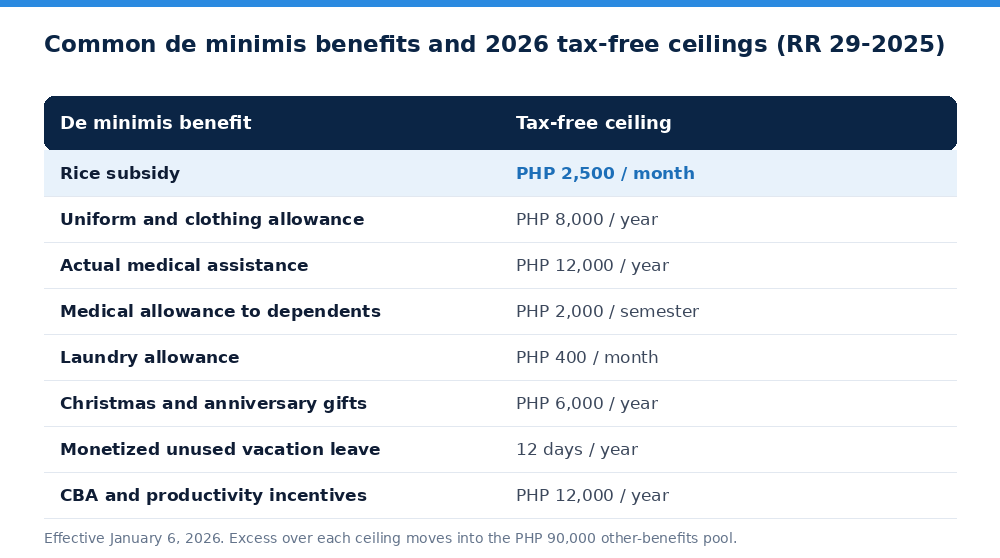
Below is the current BIR list of de minimis benefits with the ceilings that apply from January 6, 2026 onward. Give up to these amounts and the benefit is fully exempt. The list is exclusive, so a perk that is not named here does not get de minimis treatment, no matter how small.
- Rice subsidy up to PHP 2,500 per month, or one 50 kg sack of rice.
- Uniform and clothing allowance up to PHP 8,000 per year.
- Actual medical assistance (annual check-ups, maternity, consultations) up to PHP 12,000 per year.
- Medical cash allowance to dependents up to PHP 2,000 per semester, roughly PHP 333 per month.
- Laundry allowance up to PHP 400 per month.
- Christmas and major anniversary gifts up to PHP 6,000 per employee per year.
- Employee achievement awards in tangible form (not cash or gift checks) up to PHP 12,000 per year.
- Monetized unused vacation leave for private employees, up to 12 days a year.
- CBA and productivity incentive benefits up to PHP 12,000 per employee per taxable year.
- Daily meal allowance for overtime and night or graveyard shifts, up to 30% of the regional basic minimum wage.
Government employees also enjoy tax-free monetization of unused vacation and sick leave credits under separate rules. Always match each benefit to its correct category, because the ceilings are not interchangeable.
What happens when you exceed a ceiling
Going over a ceiling does not disqualify the whole benefit. Only the excess over the ceiling loses its de minimis status. The portion within the limit stays completely tax-free.
Say you give a rice subsidy of PHP 3,000 a month. The first PHP 2,500 is exempt de minimis. The remaining PHP 500 per month, or PHP 6,000 for the year, does not vanish, it simply moves into a different bucket. That excess is added to the employee's "other benefits", which are tested against a separate PHP 90,000 ceiling that also covers the 13th month pay and other bonuses.
This two-step treatment is where many payroll mistakes happen. Employers see "tax-free" and assume the entire allowance is exempt. In reality, the excess needs to be tracked and carried into the 13th month and other benefits computation, where it may still be tax-free, or may become taxable, depending on how much room is left under the PHP 90,000 cap.
Note too that the ceilings run on different clocks. Rice and laundry allowances are monthly limits, so you test them month by month. Uniform, gifts, and medical assistance are annual limits, so you keep a running yearly total per employee. A one-off catch-up payment can push a monthly item over its limit even if the yearly average looks fine, so it pays to compute the excess against the correct period rather than eyeballing the total.
How the PHP 90,000 cap interacts
The Philippine tax code exempts up to PHP 90,000 of 13th month pay and "other benefits" per employee per year. Benefits that stay within their de minimis ceilings do not touch this PHP 90,000 at all, so they are a genuine bonus on top of it. The excess-over-ceiling amounts, however, are pushed into this same PHP 90,000 pool.
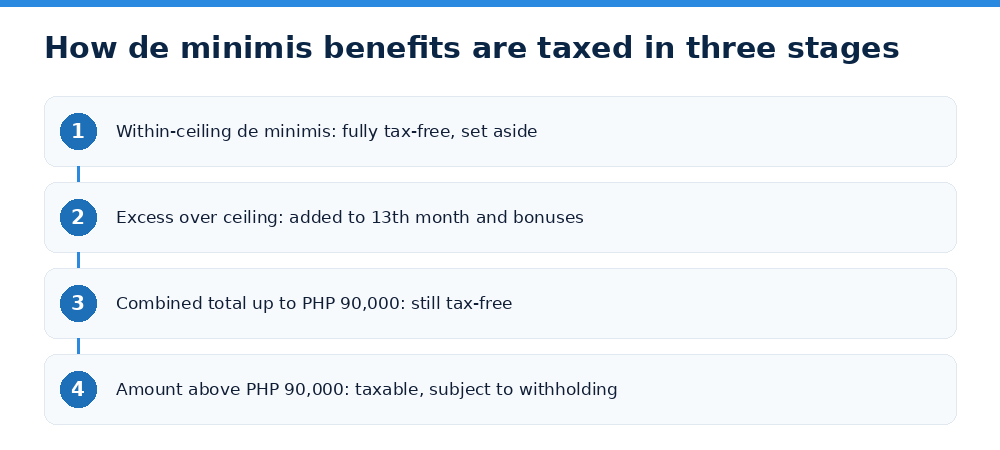
The order of the test matters, so it helps to think of it in stages:
- Stage 1: Benefits within de minimis ceilings are exempt and set aside.
- Stage 2: Any excess over those ceilings joins the 13th month pay and other bonuses.
- Stage 3: Total that combined amount. Up to PHP 90,000 is tax-free; anything above PHP 90,000 becomes taxable compensation subject to withholding tax.
Because de minimis excess shares the same PHP 90,000 room as the 13th month pay, generous allowances can quietly eat into the exemption. If an employee's 13th month and bonuses already sit near PHP 90,000, even a small de minimis excess can tip part of it into taxable territory.
A quick peso example
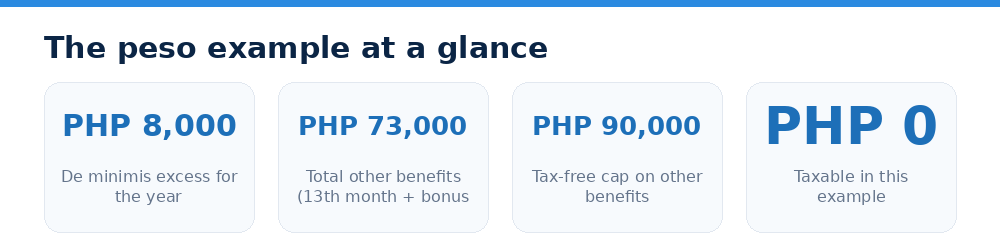
Let's put it together for a rank-and-file employee in 2026. Suppose she receives a rice subsidy of PHP 3,000 a month, a uniform allowance of PHP 10,000 a year, 13th month pay of PHP 40,000, and a performance bonus of PHP 25,000.
Her rice subsidy is PHP 500 over the PHP 2,500 monthly ceiling, so PHP 6,000 for the year is excess. Her uniform allowance is PHP 2,000 over the PHP 8,000 limit. That is PHP 8,000 of total de minimis excess. Added to her PHP 40,000 13th month and PHP 25,000 bonus, her "other benefits" reach PHP 73,000.
Since PHP 73,000 is below the PHP 90,000 cap, all of it stays tax-free, and only the within-ceiling de minimis portions were exempt from the start. Nothing becomes taxable this year. But if her bonus had been PHP 50,000, the total would hit PHP 98,000 and PHP 8,000 would be taxable. Same benefits, very different result, decided entirely by that PHP 90,000 line.
Practical tips for employers
De minimis benefits are one of the friendliest tools in Philippine payroll, but only when tracked properly. A few habits keep you clean:
- Map every allowance to a category. If a perk is not on the BIR list, it is taxable, so name it correctly or treat it as regular pay.
- Track excess per employee, per period. Monthly limits (rice, laundry) and annual limits (uniform, gifts) need different running totals.
- Watch the PHP 90,000 running balance as the year progresses, especially before releasing December bonuses.
- Keep receipts and policies for actual medical assistance and achievement awards, which the BIR may ask to substantiate.
- Confirm the latest ceilings each year, since RR 29-2025 shows these figures do change.
Doing this by hand across a growing team gets messy fast. Sahodly classifies de minimis benefits, tracks each ceiling, and rolls the excess into the PHP 90,000 test automatically, so your withholding stays correct all year. Try Sahodly free and give tax-free perks with confidence.
This article is a general guide, not tax advice. Rates are current as of 2026; verify edge cases with the BIR.