How to Compute Payroll in the Philippines: A Step-by-Step Guide
What Goes Into a Philippine Payslip
Computing payroll in the Philippines is really about turning an employee's gross pay into their net pay (take-home) by applying the right deductions in the right order. Get the sequence wrong and you either short the government or short your employee, and both are headaches you don't want.
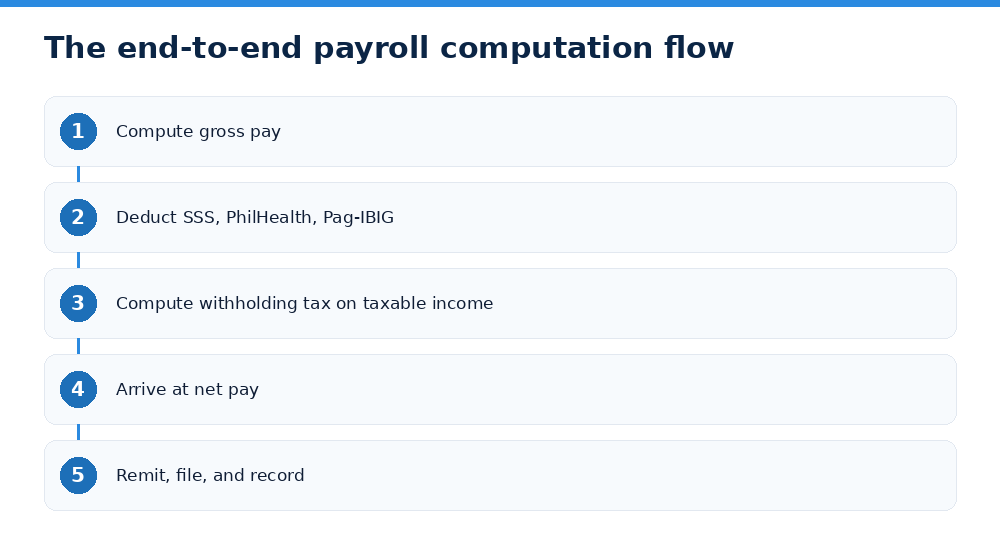
Every regular payroll run follows the same logic: start with what the employee earned, subtract the mandatory government contributions, compute withholding tax on what's left, then hand over the balance. Four deductions do most of the work: SSS, PhilHealth, Pag-IBIG, and BIR withholding tax on compensation.
In this guide we'll walk through each step in plain English, using 2026 rates, and finish with a full worked example for a PHP 25,000 monthly earner so you can see exactly where every peso goes. Whether you run payroll for two staff or twenty, the same five steps apply, and once you've done a couple of cutoffs the rhythm becomes second nature.
One thing to settle up front: payroll is a sequence, not a single formula. Each step depends on the one before it. Skip ahead to tax before you've deducted contributions and your numbers will be off for the whole period. So we'll take it in order, the same order the BIR and the agencies expect to see on your records.
Step 1: Compute Gross Pay
Gross pay is everything the employee earned for the period before any deductions. For a monthly-paid, salaried staff member this is usually just the agreed monthly rate. For daily or hourly workers, and for anyone with variable earnings, you'll build gross pay from several parts:
- Basic pay for the hours or days actually worked.
- Overtime: +25% of the hourly rate on ordinary days.
- Night shift differential: +10% for hours between 10:00 PM and 6:00 AM.
- Rest day or special non-working day work: +30% premium.
- Regular holiday pay: 200% of the daily rate for the first 8 hours worked.
- Allowances and other taxable earnings, where applicable.
To find an hourly rate, divide the daily rate by 8, since normal working hours are 8 per day. From there the premiums stack: overtime on a rest day or holiday adds a further +30% on top of the applicable hourly rate, and night differential can apply at the same time. Track each premium on its own line so the payslip is transparent and easy to audit later.
Add these together to get gross pay for the cutoff. Note that de minimis benefits within legal limits and the mandatory contributions themselves are non-taxable, so keep them clearly separated in your records; it matters once you reach the tax step. Regular allowances that form part of compensation, on the other hand, are generally taxable and belong in the gross-pay total.
Step 2: Deduct Mandatory Government Contributions
Before tax, subtract the employee's share of the three statutory contributions. These are computed on the employee's salary, not on overtime or one-off pay, and each has its own base and ceiling for 2026:
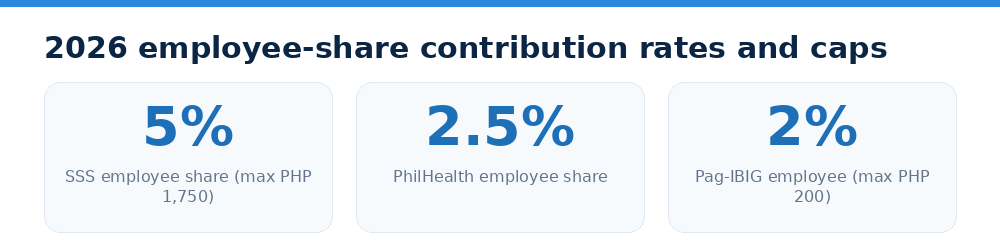
- SSS: total rate 15% of the Monthly Salary Credit (MSC), split as 5% employee and 10% employer. The MSC runs from a PHP 5,000 floor to a PHP 35,000 ceiling, so the maximum employee share is PHP 1,750/month.
- PhilHealth: 5% of monthly basic salary, split equally at 2.5% each. The salary base runs from PHP 10,000 to PHP 100,000, giving an employee share between PHP 250 and PHP 2,500.
- Pag-IBIG (HDMF): 2% employee share on monthly compensation, capped at a PHP 10,000 base, so the maximum employee share is PHP 200/month.
The SSS employer 10% already includes the Employees' Compensation (EC) contribution and, for higher MSCs, the mandatory WISP provident portion, so you don't add those separately. PhilHealth uses PHP 500 increments and Pag-IBIG a flat 2% within the cap, which keeps both straightforward once you know the salary.
Only the employee share is deducted from the payslip. The employer share (SSS 10% plus EC, PhilHealth 2.5%, Pag-IBIG 2%) is a separate company cost you remit alongside it, not a deduction from take-home pay. Knowing which peso is the employee's and which is the company's is one of the most common places small businesses slip up.
Step 3: Compute Withholding Tax on Compensation
Now compute tax, but only on taxable income. Because mandatory SSS, PhilHealth, and Pag-IBIG contributions are non-taxable, you subtract them from gross before applying the tax table:
Taxable income = Gross pay − Employee SSS − Employee PhilHealth − Employee Pag-IBIG − other non-taxable items
Apply the BIR withholding tax table under the TRAIN Law, still current for 2026. The first PHP 250,000 of annual taxable income is effectively tax-exempt. The annual brackets are:
- Up to PHP 250,000: 0%
- Over 250,000 to 400,000: 15% of the excess over 250,000
- Over 400,000 to 800,000: PHP 22,500 + 20% of the excess over 400,000
- Over 800,000 to 2,000,000: PHP 102,500 + 25% of the excess over 800,000
- Over 2,000,000 to 8,000,000: PHP 402,500 + 30% of the excess over 2,000,000
- Over 8,000,000: PHP 2,202,500 + 35% of the excess over 8,000,000
For monthly runs you can annualize the monthly taxable income, apply the table, then divide by 12, which is how the example below works.
Step 4: Arrive at Net Pay — A Worked Example
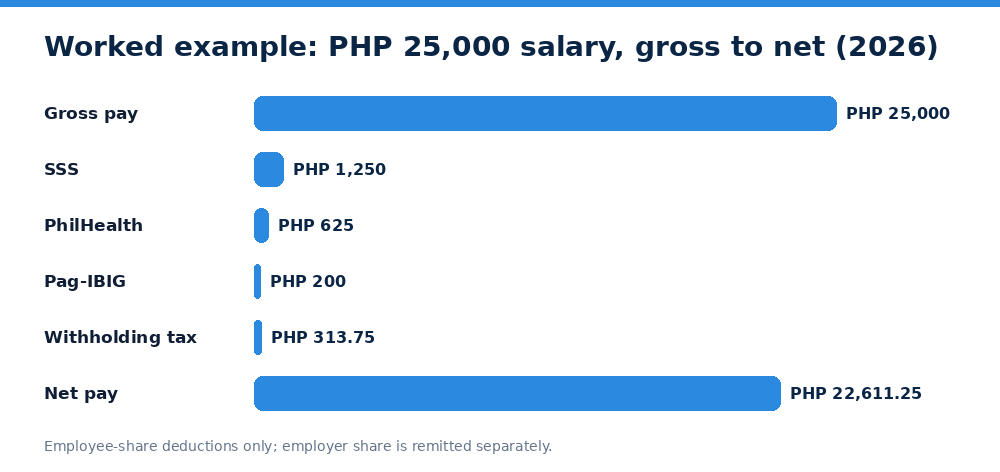
Let's put it together for an employee earning a straight PHP 25,000 monthly basic salary in 2026, with no overtime for the month.
Contributions (employee share):
- SSS: 5% × 25,000 MSC = PHP 1,250.00
- PhilHealth: 2.5% × 25,000 = PHP 625.00
- Pag-IBIG: 2% × 10,000 cap = PHP 200.00
Total contributions = PHP 2,075.00.
Taxable income = 25,000 − 2,075 = PHP 22,925.00/month, or PHP 275,100 annualized. That falls in the second bracket: 15% × (275,100 − 250,000) = PHP 3,765/year, which is PHP 313.75/month in withholding tax.
Net pay = 25,000 − 2,075 − 313.75 = PHP 22,611.25. That's the amount the employee actually takes home for the month.
Step 5: Remit, File, and Keep Records
Computing the payslip is only half the job. What you deducted (plus the employer share) must be remitted and reported on schedule:
- Remit SSS, PhilHealth, and Pag-IBIG contributions to each agency by their monthly deadlines.
- File BIR Form 1601-C, the monthly remittance return for taxes withheld on compensation.
- At year-end, issue each employee BIR Form 2316 (certificate of compensation and tax withheld) and file the annual 1604-C with the alphalist.
- Don't forget the 13th month pay: total basic salary earned in the year ÷ 12, mandatory under PD 851 and due on or before December 24. It's tax-exempt up to PHP 90,000.
Keep payslips, remittance proofs, and computations on file. Consistent records are what save you during an SSS inspection or BIR audit.
Common Mistakes and an Easier Way
A few errors show up again and again in Philippine payroll:
- Applying the tax table to gross pay instead of taxable income, so contributions never get exempted.
- Forgetting the Pag-IBIG PHP 10,000 base cap and over-deducting on higher salaries.
- Mixing up the employee and employer shares, which inflates or understates take-home pay.
- Missing remittance deadlines, which triggers penalties and surcharges.
These are exactly the steps that reward automation. This walkthrough is a practical guide, not legal or tax advice, so verify edge cases with the relevant agency. If you'd rather not run the numbers by hand every cutoff, Sahodly computes SSS, PhilHealth, Pag-IBIG, and withholding tax automatically and generates payslips in minutes. Try Sahodly free and let the math take care of itself.