Overtime, Night Differential & Holiday Pay: 2026 Cheat Sheet
First, find the hourly rate
Premium pay trips up more small businesses than almost any other part of Philippine payroll, because the rules feel fiddly and the mistakes stay invisible until an employee complains or DOLE comes knocking. The good news: once you know the four core rates, computing any shift is just layering percentages in the right order.
Every premium is built on one number: the employee's hourly rate. Get that right and the rest is arithmetic. Under the Labor Code, the standard workday is 8 hours, so the hourly rate is simply the daily rate divided by 8. A worker earning PHP 800 a day has an hourly rate of PHP 100.
Overtime, night differential, rest day, and holiday premiums are all expressed as a percentage on top of that hourly figure. Monthly-paid employees need one extra step: convert the monthly salary to a daily rate first (typically monthly x 12 divided by the number of paid days your company uses in a year), then divide by 8. The percentages below never change based on how much someone earns; they are fixed by law and apply the same way to a minimum-wage earner and a senior supervisor. Master the four core premiums and you can price any shift, no matter how the hours fall.
Overtime on ordinary days (+25%)
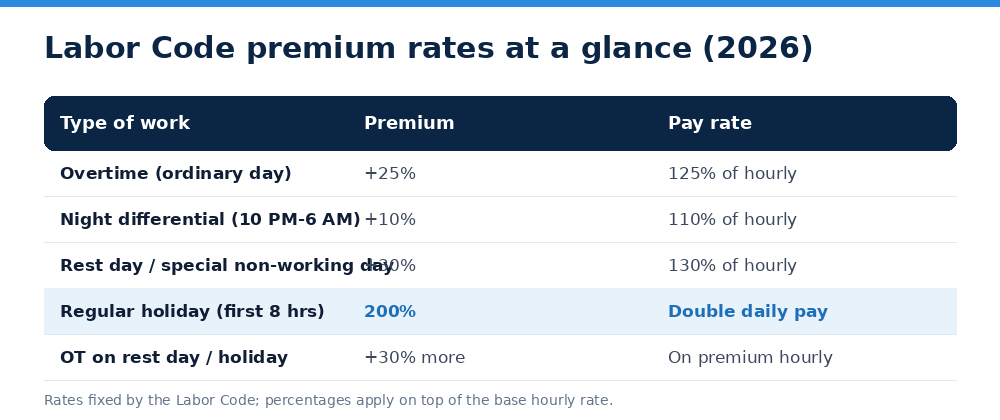
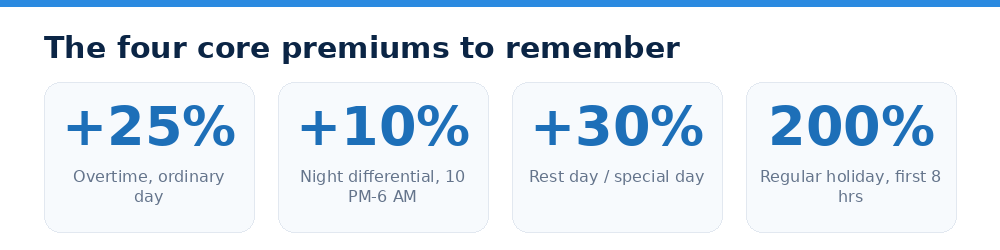
Work beyond 8 hours on an ordinary working day earns overtime pay of an extra 25% on top of the hourly rate. In plain terms, each overtime hour is paid at 125% of the regular hourly rate. Using our PHP 100 example, one overtime hour is worth PHP 125.
If a worker clocks 10 hours on a regular day, the first 8 are paid at the normal rate and the final 2 hours are paid at PHP 125 each, for PHP 250 of overtime. Overtime is computed per hour actually worked past the eighth, so partial hours are pro-rated — 30 minutes of overtime is half of one overtime hour, not a full one.
Keep in mind that overtime rendered on a rest day or holiday carries a different, higher premium (more on that below), because the base hourly rate is already elevated on those days before overtime is even added. A frequent shortcut error is applying the plain +25% to holiday overtime; that shortchanges the worker, since the +30% overtime bump should sit on top of the already-premium holiday hourly rate.
Night shift differential (+10%)
Night shift differential is an extra 10% for any work performed between 10:00 PM and 6:00 AM. It is completely separate from overtime: an employee can earn night differential without working overtime, and can work overtime without touching the night window. For one hour worked at 11:00 PM on an ordinary day, add 10% to the PHP 100 hourly rate for PHP 110.
Where hours are both overtime and inside the night window, the two premiums stack. You compute the overtime hourly rate first, then add the 10% night differential on top of that higher figure. So an overtime hour worked at 1:00 AM is PHP 125 plus 10%, or PHP 137.50 — not PHP 100 plus a flat 35%.
Missing the night differential is one of the most common payroll errors for businesses running late shifts, BPO teams, restaurants, and 24-hour convenience stores, so it is worth flagging any clock-out after 10:00 PM. Only the hours that actually fall inside the 10 PM to 6 AM window qualify; earlier hours of the same shift do not.
Rest days and special non-working days (+30%)
Two situations share the same +30% premium. Work on a scheduled rest day is paid at 130% of the regular rate, and work on a special (non-working) day is likewise paid at 130% when the employee reports for duty. Using PHP 100, an hour of work on either day is worth PHP 130.
The difference shows up when nobody works. On a special non-working day the rule is "no work, no pay" unless a company policy or CBA provides otherwise; a rest day simply shifts and is not paid if unworked. If overtime is rendered on a rest day or special day, add another 30% of the applicable (already premium) hourly rate for those extra hours.
These days are where a lot of manual computations quietly go wrong, because the base is no longer the plain hourly rate. When a rest day also falls on a special non-working day, or when a night shift lands on either, the layers add up fast — which is exactly why a clear order of operations matters.
Regular holiday pay (200%)
Regular holidays get the strongest protection in the Labor Code. An employee who works on a regular holiday earns 200% of the daily rate for the first 8 hours — double pay. Even if the employee does not work, they are still entitled to 100% of the daily wage, provided the qualifying conditions are met (such as being present or on paid leave on the workday immediately before the holiday).
With a PHP 800 daily rate, working a regular holiday pays PHP 1,600 for the day, while an unworked regular holiday still pays the usual PHP 800. This is the key contrast with special non-working days: regular holidays are fixed dates declared by law (national and major religious holidays), while special non-working days are a separate, lower-premium category.
Never assume every "holiday" means double pay — check each official proclamation before you run payroll. The list is published yearly, and the mix of regular versus special days shifts from one year to the next, so a date that was double pay last year may be a +30% special day this year.
Worked example: stacking the premiums
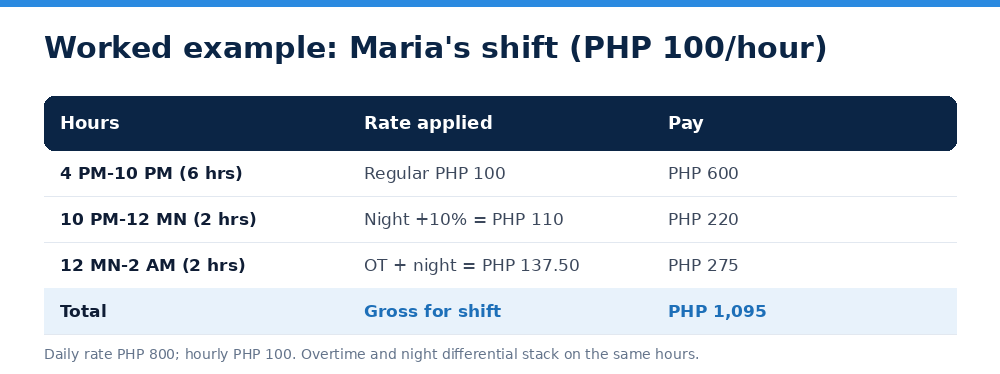
Let's put the premiums together for a single shift. Maria earns PHP 800 a day, so her hourly rate is PHP 100. On an ordinary Tuesday she works from 4:00 PM to 12:00 midnight (8 hours), then stays two more hours until 2:00 AM.
- 4:00 PM to 10:00 PM — regular hours: 6 hours x PHP 100 = PHP 600.
- 10:00 PM to 12:00 MN — still within her 8 hours but inside the night window, so +10%: 2 hours x PHP 110 = PHP 220.
- 12:00 MN to 2:00 AM — overtime and night hours: overtime rate PHP 125, plus 10% night differential = PHP 137.50; 2 hours = PHP 275.
Her gross for the shift is PHP 600 + PHP 220 + PHP 275 = PHP 1,095. The table below shows the layering step by step. Notice how the last two hours carry two premiums at once — this is exactly the kind of stacking that manual spreadsheets get wrong, especially when a single hour qualifies for both overtime and night differential. Now imagine the same shift landing on a regular holiday, and you can see why a reliable system beats mental math.
Common mistakes (and letting software do the math)
A few reminders keep you compliant. Premiums are computed on the hourly rate, not tacked onto the daily wage as a flat add-on. Night differential and overtime are independent, so both can apply to the same hour. Special non-working days and regular holidays are different categories with different rates — one is +30%, the other is 200%. And when a shift crosses several premium types at once, compute each layer in order rather than eyeballing a round number.
This is precisely where payroll software earns its keep. Sahodly reads each employee's clock-ins, applies the correct Labor Code premiums automatically, and produces a payslip that shows the full breakdown — no more late-night spreadsheet detective work. These figures are current as of 2026 and are meant as a practical guide, not legal advice; verify unusual edge cases with DOLE. Try Sahodly free and let the math take care of itself.