Semi-Monthly vs. Monthly Payroll: Which Cutoff Is Right for You?
The quick difference between the two cutoffs
Choosing a payroll cutoff is one of the first operational decisions a Philippine employer makes, and it quietly shapes everything after it: when employees get paid, how you time government remittances, and how much bookkeeping lands on your desk each month.
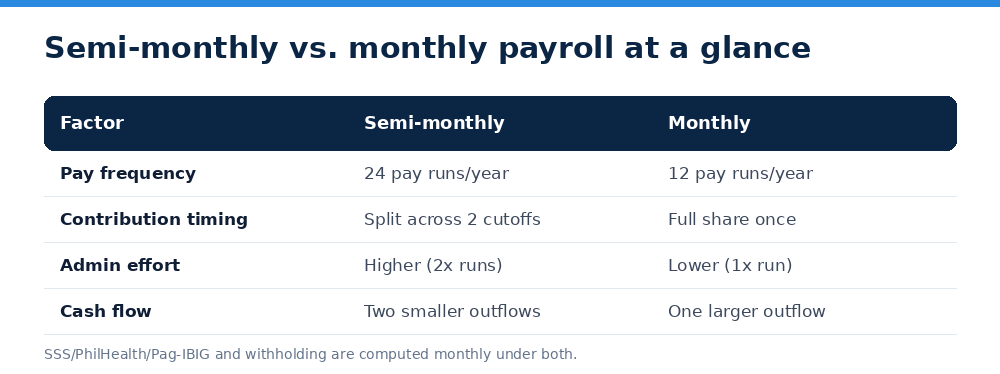
The two most common schedules here are semi-monthly and monthly payroll. Semi-monthly means paying twice a month, most often on the 15th and the end of the month, so employees receive 24 paychecks a year. Monthly means one payout per month, or 12 paychecks a year.
Under the Labor Code, rank-and-file employees must be paid at least twice a month at intervals not exceeding 16 days, which is exactly why semi-monthly is the default for most companies. Monthly runs are still used, but usually for managerial staff, very small teams, or setups where everyone agrees to it. Whichever you pick, the underlying government rules do not change. What changes is timing and effort.
How pay frequency actually plays out
The clearest way to see the contrast is to look at an employee earning a fixed monthly salary. Say a staff member is paid PHP 30,000 a month. On a semi-monthly cutoff, they typically receive around PHP 15,000 gross per payout (before deductions), twice a month. On a monthly cutoff, they receive the full PHP 30,000 gross once.
Neither schedule changes the employee's annual pay. A worker on PHP 30,000/month earns PHP 360,000 a year on both. The difference is cash-flow rhythm: semi-monthly smooths the employee's household budgeting into two smaller inflows, while monthly gives one larger inflow they must stretch across the entire month.
- Semi-monthly: 24 pay runs a year, smaller and more frequent, aligned to a 1–15 and 16–end-of-month coverage.
- Monthly: 12 pay runs a year, one larger payout, simpler to schedule but harder for employees to budget.
For businesses with daily-wage or hourly staff, semi-monthly also tracks worked hours in tighter windows, which many owners find easier to reconcile against timesheets.
It is worth stressing that the choice of cutoff is not about paying employees more or less. A common misconception among new employers is that semi-monthly somehow costs the company more because there are more paydays. It does not. The salary is annualized the same way; you are only deciding the size and cadence of each release. The real cost difference shows up in your own processing time and in how predictable each side's cash flow feels.
How SSS, PhilHealth, and Pag-IBIG apply per cutoff
This is where employers get tripped up, so here is the key rule: statutory contributions are computed on a monthly basis regardless of how often you pay. SSS, PhilHealth, and Pag-IBIG are all monthly obligations. Your cutoff only decides how you deduct and stage the employee share, not the total owed.
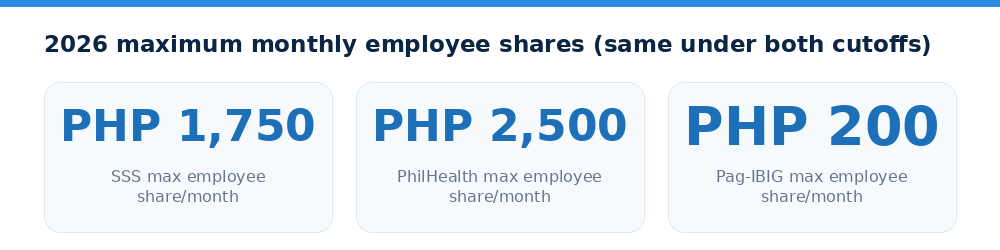
Using the 2026 figures, the full monthly employee shares are:
- SSS: 5% of the Monthly Salary Credit (MSC), up to a maximum employee share of PHP 1,750 (5% of the PHP 35,000 ceiling). The employer adds 10%.
- PhilHealth: 2.5% of monthly basic salary as the employee share, ranging from PHP 250 to PHP 2,500, matched by 2.5% from the employer.
- Pag-IBIG: 2% of monthly compensation for the employee (1% if monthly comp is PHP 1,500 or below), capped at PHP 200 because the maximum compensation for computation is PHP 10,000. The employer also contributes 2%.
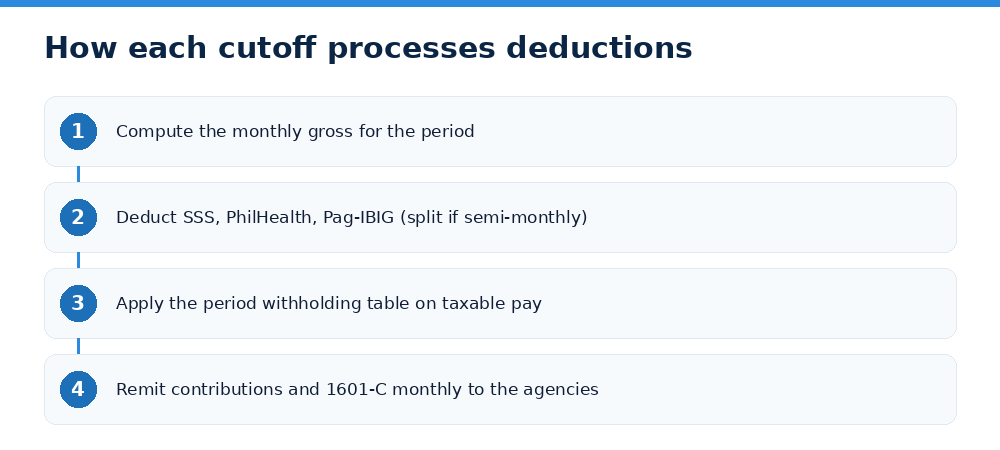
On a monthly cutoff, you deduct the whole employee share once. On a semi-monthly cutoff, employers usually split each monthly contribution into two halves and deduct one half per payout, so by month-end the correct total is collected. Some employers instead deduct the full contribution on only one cutoff (often the second). Both approaches are acceptable as long as the monthly total matches the contribution tables and is remitted on time. What you must never do is compute contributions twice on the full salary just because you paid twice.
How withholding tax works under each schedule
Withholding tax on compensation follows the BIR revised withholding tax table, which has separate columns for each payroll period, including a semi-monthly column and a monthly column. These period tables are derived from the same TRAIN Law annual brackets, so the tax withheld across the year lands in the same place under both cutoffs.
The anchor to remember is the annual exemption: the first PHP 250,000 of annual taxable income is effectively tax-free. Spread across periods, that works out to roughly PHP 20,833 per month or about PHP 10,417 per semi-monthly cutoff of tax-exempt room. An employee below that threshold each period generally has zero withholding on both schedules.
Two things stay constant no matter the cutoff:
- Mandatory SSS, PhilHealth, and Pag-IBIG contributions are non-taxable, so you subtract them before applying the tax table.
- The annual tax due is the same. If period withholding slightly over- or under-collects, the year-end adjustment (reflected in BIR Form 2316) trues it up.
The practical upside of a semi-monthly cutoff is that withholding is spread into smaller, more frequent bites, which softens the deduction employees see on any single payslip. Monthly cutoffs concentrate the tax into one larger deduction. Remittance of what you withhold is still monthly via BIR Form 1601-C, no matter your pay frequency.
Admin effort and cash flow trade-offs
Here is the honest trade-off. Semi-monthly is friendlier to employees but heavier on you; monthly is lighter on you but harder on employees' budgeting.
Admin effort. A semi-monthly schedule means you run payroll 24 times a year: twice the payslip generation, timekeeping reconciliation, and payout batches compared with monthly's 12. If you compute manually or in spreadsheets, that doubles the room for error. Payroll software largely erases this gap because the app runs both cutoffs, splits contributions, and applies the correct withholding table automatically.
Cash flow. Semi-monthly spreads your cash outflow into two smaller releases, which can be easier for a small business managing a tight bank balance. Monthly requires one larger lump sum on payday, so you need the full amount ready at once. On the government side, remittances (SSS, PhilHealth, Pag-IBIG, and 1601-C withholding) remain monthly under both schedules, so contribution timing does not actually change your remittance calendar.
In short, your cutoff mainly moves employee cash-flow rhythm and your internal workload. It does not change what you owe the agencies.
Which cutoff is right for you?
There is no universally correct answer, but a few patterns hold up well for Philippine SMEs:
- Choose semi-monthly if you employ rank-and-file or daily-wage staff, want to comply cleanly with the twice-a-month pay rule, and want employees to have steadier household cash flow. This is the safest default for most businesses.
- Choose monthly if your team is small, salaried, and managerial, everyone is comfortable with one payout, and you want to minimize the number of pay runs. Just confirm your arrangement respects Labor Code pay-interval requirements for covered employees.
Many companies also run a hybrid: monthly for management, semi-monthly for rank-and-file. That is perfectly workable as long as each group's contributions and withholding are computed on the correct monthly basis.
Whatever you decide, keep the golden rule in mind: contributions and taxes are monthly obligations, and your cutoff only changes when and how you stage the deductions, never the totals. Sahodly handles both semi-monthly and monthly cutoffs, splits statutory shares correctly, and applies the right withholding table for each period, so you can switch schedules without recomputing anything by hand. Try Sahodly free and run your first cutoff in minutes.