The 1604-C Alphalist and DAT File, Demystified
What the 1604-C actually is
If you run payroll in the Philippines, you already meet the BIR every month through Form 1601-C — your Monthly Remittance Return of Income Taxes Withheld on Compensation. Every payday you deduct income tax from your employees, and every month you remit it and file the return. The 1604-C is the annual bookend to all those monthly filings.
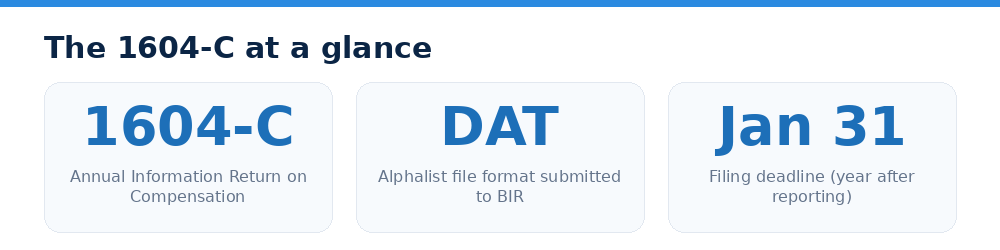
Officially, Form 1604-C is the Annual Information Return of Income Taxes Withheld on Compensation. It summarizes, for one calendar year, the total compensation you paid and the total tax you withheld from your employees. Think of it as the yearly reconciliation: the BIR uses it to confirm that what you remitted month by month lines up with the full-year picture, employee by employee.
But the 1604-C rarely travels alone. Attached to it is the Alphalist — an alphabetical list of every employee together with the exact figures behind their compensation and withholding for the year. That Alphalist is submitted as a DAT file, and it is the part that causes small-business owners and HR staff the most confusion. In this guide we will walk through what the file actually contains, who has to file it, the deadline you cannot miss, and the steps to prepare and submit it without the last-minute panic.
Inside the Alphalist DAT file
A DAT file is simply a structured text file that the BIR's systems can read automatically. You do not type it out by hand or open it in Word — you generate it using the BIR's free Alphalist Data Entry and Validation Module (or a payroll tool that exports the same format), and the software packages your employee data into the exact layout the BIR expects. The .dat extension just signals that it is data meant for a machine, not a document meant for a human.
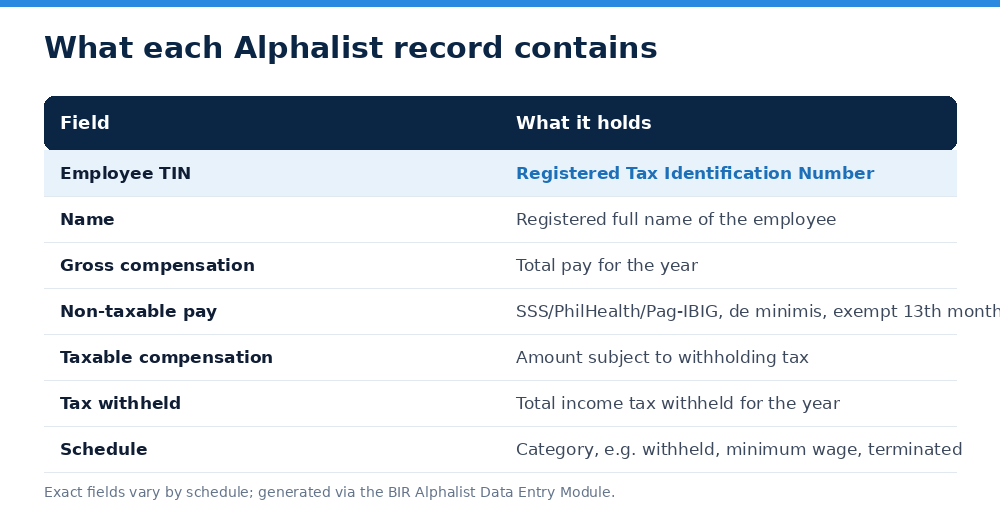
The Alphalist for compensation is split into schedules that group employees by situation — for example, employees whose tax was actually withheld, minimum wage earners who are exempt, employees qualified for substituted filing, and employees terminated during the year. Each schedule expects a specific set of people, and placing someone correctly is part of getting the file right. For every person, the file carries their identifying and financial details so the BIR can cross-check them against your monthly remittances and each employee's annual Form 2316.
Because the DAT file is machine-read, precision matters more than it does on a paper form. A wrong TIN, a missing centavo, or a total that does not tie out to your twelve monthly 1601-C filings can bounce the whole submission — the system does not negotiate. The table below shows the core information every Alphalist record includes.
Who must file, and the deadline
Every employer who withholds income tax on compensation must file the 1604-C with its Alphalist — this includes small businesses, even if you only have a handful of staff. If you registered as a withholding agent for compensation and filed 1601-C at any point during the year, the annual 1604-C applies to you. Having zero tax to remit in some months does not exempt you; the annual return still summarizes the year.
The filing deadline is January 31 of the year following the calendar year being reported. So compensation paid during 2026 is reported on a 1604-C due on or before January 31, 2027. The Alphalist DAT file must be submitted by the same deadline. Note that this is separate from the annual Form 2316 you issue to each employee, which supports the same year-end reconciliation.
Miss the January 31 date and you expose yourself to BIR penalties, surcharges, and interest for late filing — the kind of avoidable cost that stings a small business and invites unwanted scrutiny. Mark the date early: January fills up fast with year-end compliance tasks, and leaving the Alphalist to the last week is how validation errors turn into a late submission.
How to prepare and submit the DAT file
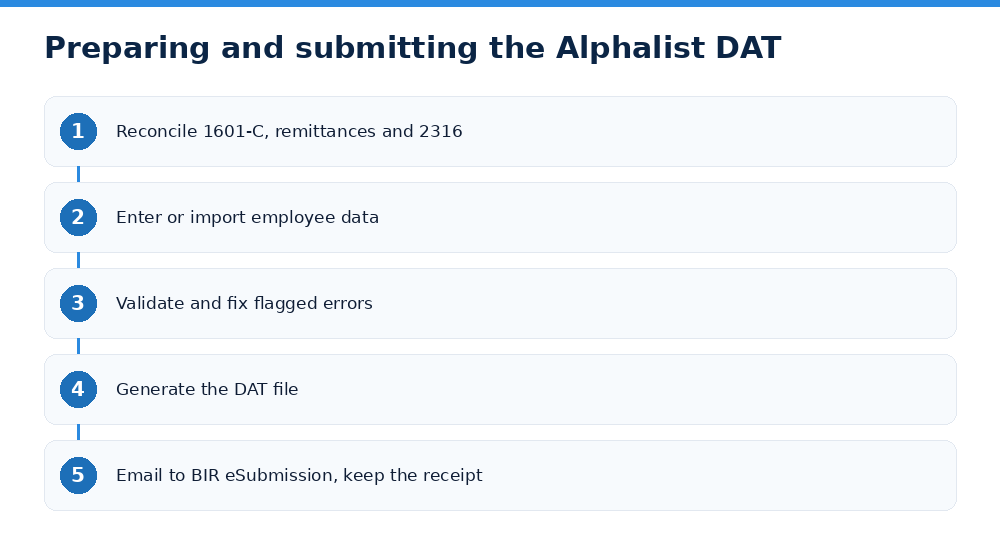
The process has a clear sequence once you know the tools involved. Two different BIR channels are in play — one for the return, one for the file — so it helps to keep them straight. Here is the practical path most employers follow:
- Reconcile your payroll year first. Make sure your 12 monthly 1601-C returns, your remittances, and each employee's 2316 all agree. The Alphalist should be the summary of numbers you already filed — not a fresh calculation.
- Enter or import the data. Use the BIR's Alphalist Data Entry Module to key in (or import) each employee record, or export a ready DAT file from your payroll software.
- Validate. Run the module's validation to catch TIN errors, missing fields, and totals that do not balance. Fix everything it flags before moving on.
- Generate the DAT file. The validated data is packaged into the official DAT format.
- Submit through eSubmission. Email the DAT file to the BIR's dedicated eSubmission address (esubmission@bir.gov.ph). You will receive a confirmation — keep it as proof of filing.
The 1604-C return itself is filed through eBIRForms or eFPS, while the Alphalist DAT is lodged via eSubmission. Keep both acknowledgements together in your records.
Common mistakes that get submissions rejected
Most DAT headaches come from a short list of recurring errors. Watch for these:
- Mismatched TINs or names. A transposed digit or a nickname instead of the registered name will fail validation or create matching problems on the BIR side.
- Totals that do not tie out. If the Alphalist total for withheld tax does not equal the sum of your monthly 1601-C remittances, expect follow-up.
- Wrong schedule placement. Minimum wage earners, employees with substituted filing, and terminated staff belong in specific schedules — putting someone in the wrong one distorts the return.
- Using an outdated module version. The BIR updates the Data Entry Module periodically. An old version can produce a file the current system will not accept.
- Leaving it to the last day. If validation surfaces errors on January 31, you may run out of time to correct and resubmit.
None of these are hard to avoid — they simply require clean payroll records kept current all year, not reconstructed in a panic each January. A good habit is to run a quick reconciliation every quarter so any mismatch surfaces while it is still small and easy to trace, rather than as a stack of unexplained differences at year-end.
Make year-end painless
The 1604-C and its Alphalist DAT are not complicated in theory — they are a summary of numbers you already reported. The difficulty is almost always in the details: accurate TINs, tidy monthly filings, and figures that reconcile cleanly across 1601-C, 2316, and the Alphalist. Get those right through the year and January becomes a formality rather than a fire drill.
When your payroll runs on software that tracks withholding correctly every pay period and keeps employee records consistent, year-end stops being a scramble. Instead of rebuilding a year of numbers from scattered spreadsheets, you are simply exporting what is already there, validating it, and sending it in.
This article is a general guide, not tax advice — rates and procedures are current as of 2026, and you should confirm edge cases with the BIR or your accountant. Sahodly helps Philippine small businesses keep clean, compliant payroll records all year so annual filings like the 1604-C are far less painful — try Sahodly free and start your next year-end with your numbers already in order.