BIR Form 1601-C: A Simple Guide to Monthly Withholding Remittance
What is BIR Form 1601-C?
BIR Form 1601-C is the Monthly Remittance Return of Income Taxes Withheld on Compensation. In plain terms, it is the form your business uses to declare and hand over to the Bureau of Internal Revenue (BIR) the withholding tax you deducted from your employees' salaries during the month.
When you run payroll, part of each taxable employee's pay is held back as withholding tax under the TRAIN Law. That money is not yours to keep. You are acting as the government's collection agent, and Form 1601-C is how you settle up every month. It reports how much you withheld from the whole team and remits that amount to the BIR.
Think of it as a monthly checkpoint: you collected tax on the government's behalf, and 1601-C makes sure it actually reaches them, on time and correctly documented. It is one of the most routine returns a Philippine employer files, but also one of the easiest to slip up on because it comes due twelve times a year, without fail. Getting the rhythm right early saves you from penalties and open cases down the line.
Who needs to file it?
You are required to file 1601-C if you are a withholding agent on compensation which, in practice, means almost every employer with staff on payroll. This includes:
- Sole proprietors, partnerships, and corporations with employees
- Non-profits, cooperatives, and associations that pay salaries
- Government offices and instrumentalities
Here is the part that trips people up: you must file every month, even if no tax was withheld. If all your staff earn below the taxable threshold (the first PHP 250,000 of annual taxable income is effectively tax-exempt), your remittance may be zero, but you still file a return showing zero. Skipping a "zero" month is one of the most common ways small businesses rack up open-case penalties.
If you pay professionals, suppliers, or contractors, that is expanded withholding and uses different forms (0619-E or 1601-EQ), not 1601-C. Keeping the two streams separate from the start avoids a lot of confusion at year-end, when the compensation figures flow into your annual 2316 certificates and the 1604-C, while supplier withholding is reconciled through the 1604-E. If you are unsure which bucket a payment belongs to, the test is simple: if the person is your employee under an employer-employee relationship, it is compensation and goes on 1601-C.
What information you report
Form 1601-C summarizes your compensation and withholding for a single month. You are reporting the totals for your whole workforce, not a per-employee breakdown (the per-employee detail comes later in the annual 2316 and 1604-C with the Alphalist).
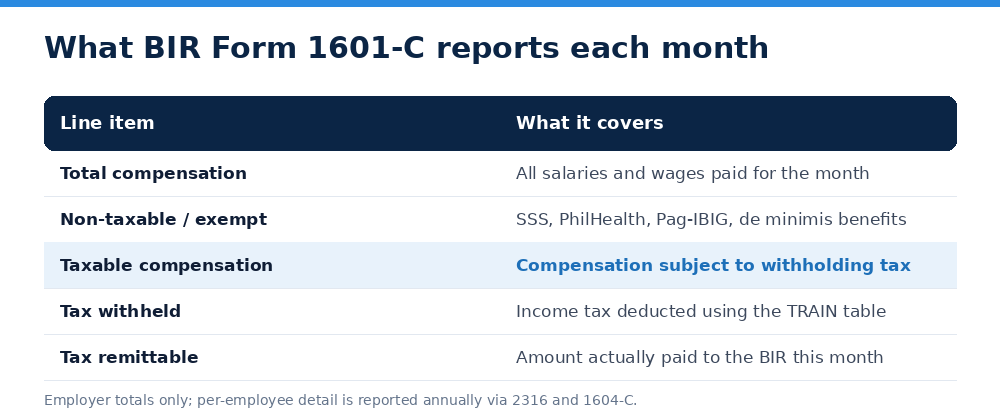
The core figures you enter are total compensation paid, the portion that is non-taxable, the taxable balance, and the tax actually withheld. Statutory contributions such as SSS, PhilHealth, and Pag-IBIG are non-taxable, so they reduce the taxable base before withholding is computed. De minimis benefits within their legal limits are also excluded. The form separates these categories so the BIR can see clearly how you arrived at the tax withheld. The table below shows the main lines at a glance.
A quick peso example. Say you have five employees and your total gross compensation for the month is PHP 250,000. Of that, PHP 18,000 goes to mandatory SSS, PhilHealth, and Pag-IBIG contributions, and PHP 12,000 is non-taxable de minimis and 13th month allowance within the exempt ceiling. That leaves PHP 220,000 as taxable compensation. After applying the TRAIN withholding table to each employee's share, suppose the combined tax withheld comes to PHP 21,500. That PHP 21,500 is the figure you remit on 1601-C for the month; the PHP 30,000 in exempt items never enters the tax computation.
How the monthly remittance process works
The workflow is the same every month once you have it set up. Most small businesses now file electronically through eBIRForms (the free offline package you download from the BIR website) or, for larger or mandated taxpayers, eFPS (the Electronic Filing and Payment System). Manual over-the-counter filing still exists for a few taxpayers, but electronic filing is now the norm and is required for most withholding agents.
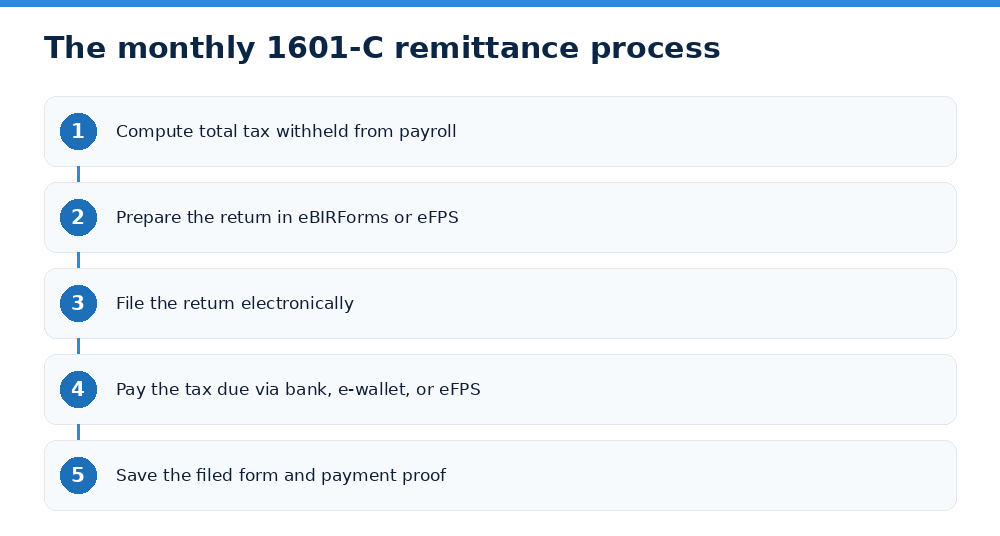
A typical cycle looks like this:
- Compute: Run payroll and total the withholding tax across all employees for the month.
- Prepare the return: Enter your totals into eBIRForms or eFPS, which computes the tax due.
- Submit: File the return electronically and receive your confirmation or Tax Return Receipt.
- Pay: Settle the amount due through an accredited channel such as an authorized agent bank, GCash, Maya, or the eFPS payment gateway.
- Keep records: Save the filed form and proof of payment for your files and future audits.
The flow diagram below sums up the five steps.
Deadlines you cannot miss
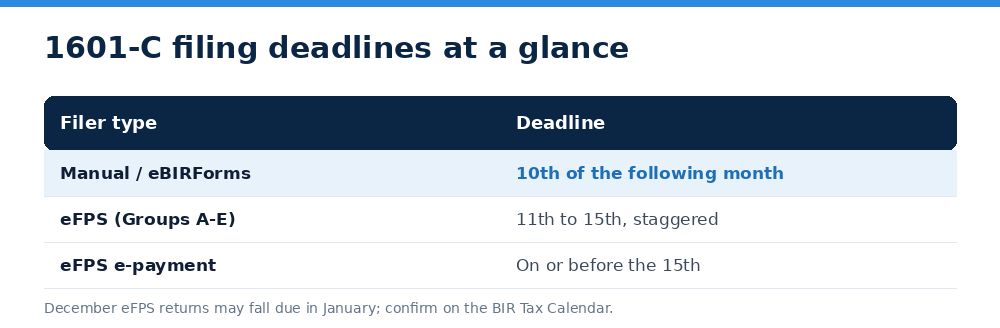
For manual and eBIRForms filers, 1601-C is due on or before the 10th day of the month following the month the tax was withheld. So tax withheld in January 2026 is filed and paid by February 10, 2026.
Businesses enrolled in eFPS follow a staggered schedule based on their industry group (Groups A through E), e-filing between the 11th and 15th, with e-payment due by the 15th. December has a special quirk: under the staggered regime, the December return for eFPS users can fall due in January of the following year, so always confirm the exact date on the official BIR Tax Calendar.
Late filing is expensive. The BIR imposes a 25% surcharge, 12% annual interest on the unpaid tax, and a compromise penalty per return. Those charges stack on every late month, so a habit of filing a day or two late can quietly turn into thousands of pesos in avoidable penalties over a year. Filing a zero return on time costs nothing; missing it does not. A simple safeguard is to set a recurring reminder a few days before the deadline and to prepare the return as soon as payroll is finalized, rather than waiting until the deadline week.
Common mistakes to avoid
A few recurring errors cause most 1601-C headaches:
- Skipping zero-tax months. No tax due still means a return is due. Non-filing creates an open case in the BIR system.
- Mixing up form types. 1601-C is for compensation only. Payments to suppliers and professionals belong on 0619-E or 1601-EQ.
- Taxing what is non-taxable. Mandatory SSS, PhilHealth, and Pag-IBIG contributions and de minimis benefits are excluded from the taxable base. Include them and you over-withhold.
- Wrong month or wrong RDO details. Double-check the return period and your registered details before submitting.
- Filing but forgetting to pay. The return and the payment are two separate steps; both must be done by the deadline.
This guide is general information, not tax advice. For edge cases or unusual pay structures, check with the BIR or your accountant.
Make monthly remittance painless
The good news: 1601-C is repetitive by design. Once your payroll correctly separates taxable and non-taxable pay and applies the TRAIN withholding table, the monthly totals practically write themselves. The hard part is doing it accurately, every single month, without letting a deadline slip.
That is exactly the kind of routine work software handles well. Sahodly computes each employee's withholding tax as you run payroll, tracks the non-taxable contributions automatically, and gives you the monthly totals you need for your 1601-C, so filing becomes a quick copy-over instead of a manual scramble.
Want to take the stress out of monthly remittance? Try Sahodly free and let your payroll do the math.