BIR Form 2316 Explained: What It Is and How to Prepare It
What Is BIR Form 2316?
BIR Form 2316, officially the Certificate of Compensation Payment / Tax Withheld for Compensation Payment With or Without Tax Withheld, is a document every Philippine employer must issue to each employee once a year. It summarizes the total compensation you paid an employee during the calendar year and the total income tax you withheld and remitted to the Bureau of Internal Revenue (BIR) on their behalf.
Think of it as a year-end receipt for tax purposes. It confirms, in writing, that the correct tax was computed and paid on an employee's salary. For most rank-and-file workers, this single form is all they need to prove their income and taxes for the year, so getting it right matters to both you and your team.
It is different from the forms you file during the year. Form 1601-C is your monthly remittance of taxes withheld on compensation, while Form 2316 is the annual, per-employee certificate that pulls the whole year together. In short, 1601-C keeps the cash flowing to the BIR month by month, and 2316 is the year-end proof that the totals add up correctly for each individual worker.
Every employer that pays compensation income must issue one — from a single-person startup to a large enterprise. There is no minimum headcount and no exemption for small businesses. If you have even one employee on the payroll, you owe them a 2316, and the BIR expects your copies too. That makes it one of the most universal compliance obligations in Philippine payroll.
What Information the Form Contains
Form 2316 packs a full year of payroll into one page. The main items are:
- Employee and employer details — names, addresses, and Taxpayer Identification Numbers (TINs) of both parties.
- Gross compensation — the total salary, allowances, and taxable benefits paid for the year.
- Non-taxable / exempt income — mandatory SSS, PhilHealth, and Pag-IBIG contributions, the 13th month pay and other benefits that fall within the tax-exempt ceiling, and de minimis benefits.
- Taxable compensation — gross pay minus the non-taxable portion.
- Tax due and tax withheld — the annual tax computed against the TRAIN Law table versus what you actually withheld across the year.
- Signatures — since the pandemic-era exception ended, both the employer's authorized signatory and the employee must sign.
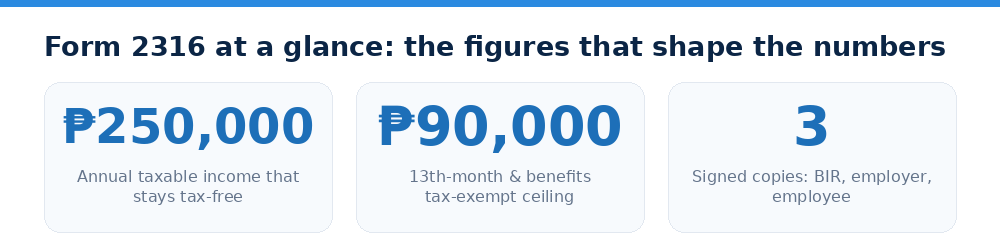
Remember that the first PHP 250,000 of annual taxable income is effectively tax-exempt, and the 13th month pay plus other benefits are tax-free up to a PHP 90,000 ceiling. These thresholds are why an accurate non-taxable column is so important.
Substituted Filing: The Whole Point
For most employees, Form 2316 does something powerful: it lets them skip filing their own annual income tax return (Form 1700). This is called substituted filing, and it works when all of these are true:
- The employee earned purely compensation income — salary only, no business or professional income.
- They worked for one employer for the whole calendar year (or their current employer consolidated a previous employer's figures).
- The tax withheld equals the tax due after the year-end adjustment.
- The employer files the annual return, Form 1604-C, with the alphalist.
When these conditions are met, the signed Form 2316 becomes the employee's income tax return — no separate filing needed. If an employee had two employers during the year, or earned income on the side, they generally will not qualify and must file Form 1700 themselves. This is general guidance, not tax advice, so confirm edge cases with the BIR or your accountant.
For employees, this is a real convenience: a properly done 2316 means one less form to worry about every April. For employers, it is a responsibility — because you are effectively filing on your team's behalf, the accuracy of your annualization directly affects whether each person is compliant. Getting the year-end adjustment right is what makes substituted filing hold up.
How to Prepare Form 2316: Year-End Steps
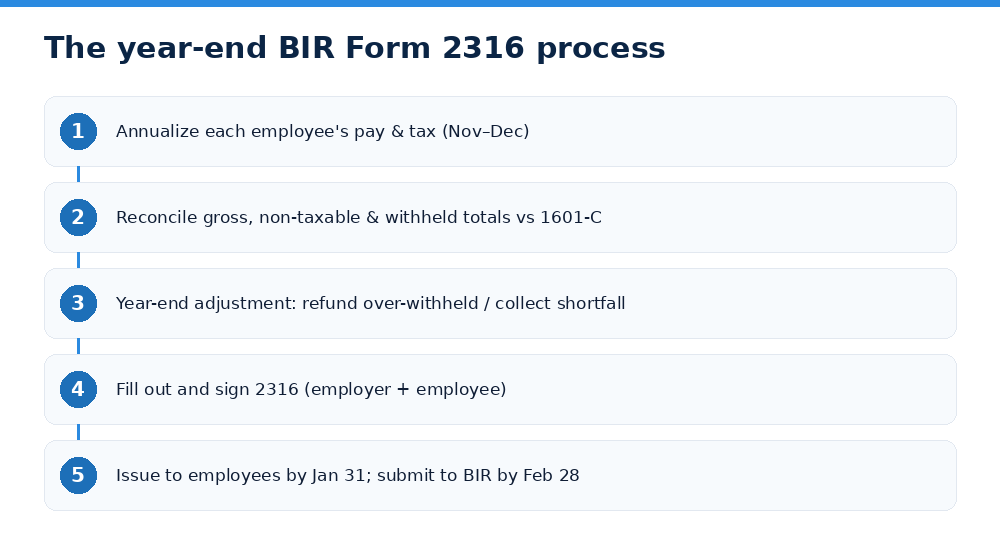
Preparing 2316 is the finish line of your year-end payroll (or “annualization”) process. Here is the practical flow:
- Annualize each employee's pay and tax. Around November to December, add up the full year's gross compensation, non-taxable items, and tax already withheld per person.
- Reconcile the totals. Make sure your monthly 1601-C remittances match the annual figures. Catch any missing months, corrections, or mid-year salary changes.
- Do the year-end adjustment. Compare tax due against tax withheld. If you over-withheld, refund the difference in the employee's final December (or January) pay. If you under-withheld, collect the shortfall.
- Fill out and sign the form. Enter the reconciled figures into Form 2316, then have both the employer signatory and the employee sign it.
- Distribute and submit. Give each employee their copy, then file the BIR's copies for substituted filing.
A quick example: say an employee earned PHP 480,000 in gross pay, with PHP 30,000 in mandatory contributions and a PHP 40,000 13th month pay that sits under the exempt ceiling. Their taxable compensation would be PHP 410,000. Against the TRAIN table, the tax due on that falls in the second bracket, and your job at year-end is to confirm the tax you withheld month by month lands on that same number. If it does not, you adjust the final pay before the form is signed.
Payroll software removes most of the manual math here — the annualization and the 2316 figures are generated straight from the year's records, so you are reviewing numbers rather than rebuilding them. That is the difference between a calm January review and a week of reconciling spreadsheets by hand.
Key Deadlines and Figures to Remember
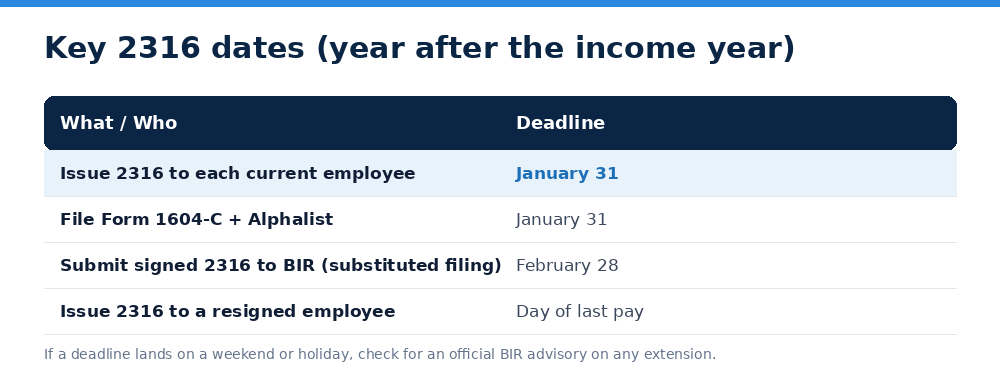
The 2316 timeline is tight and clusters in January and February of the year after the income year. Mark these:
- January 31 — issue Form 2316 to every current employee.
- January 31 — file Form 1604-C (Annual Information Return) together with the alphalist of employees.
- February 28 — submit the signed 2316 copies to the BIR to complete substituted filing.
- Day of last payment — for a resigned employee, issue their 2316 on the day you release their final pay, so they can hand it to their next employer.
If any deadline falls on a weekend or holiday, check for an official BIR advisory, as the agency sometimes moves or extends dates. Missing these can expose you to penalties and leaves employees unable to prove their income for loans, visas, or a new job.
Common Mistakes and How to Stay Ready
A few errors show up every filing season:
- Mismatched TINs or names — a wrong TIN can invalidate substituted filing. Verify employee details before year-end, not during the rush.
- Skipping the year-end adjustment — if tax withheld does not equal tax due, the employee loses substituted-filing eligibility and may need to file on their own.
- Wrong non-taxable amounts — forgetting to exclude mandatory SSS, PhilHealth, and Pag-IBIG contributions, or misapplying the PHP 90,000 benefit ceiling, throws off the taxable base.
- Missing signatures — both parties must sign; unsigned forms are not valid for submission.
- Forgetting resigned staff — their 2316 is due on their last pay date, not at year-end.
The cleanest defense is accurate, consolidated payroll records all year long, so December is a review rather than a scramble. Sahodly keeps every month's compensation, contributions, and withholding in one place and helps you annualize and generate year-end figures without the spreadsheet gymnastics. Try Sahodly free and make your next 2316 season a quiet one.