Final Pay in the Philippines: What's Included and When It's Due
Final pay vs. back pay: same thing, different name
When an employee resigns, is terminated, or reaches the end of a contract, one question comes up fast: “Kailan ang back pay ko?” In everyday conversation, Filipinos say back pay. In DOLE's official guidance, the term is final pay (also called last pay or last wages). They mean the same thing — the sum of every amount still owed to a departing employee, released as one settlement after separation.
Final pay matters to both sides. For the employee, it's money already earned that should not be held hostage. For the employer, computing it correctly and releasing it on time is a legal obligation and a reputation issue — nothing sours an exit faster than a back pay that drags for months. This guide breaks down what belongs in final pay, how to compute the common components, and the deadline DOLE expects you to hit.
This article is general information, not legal advice. For contested dismissals or unusual contract terms, consult DOLE or a labor lawyer.
What's included in your final pay
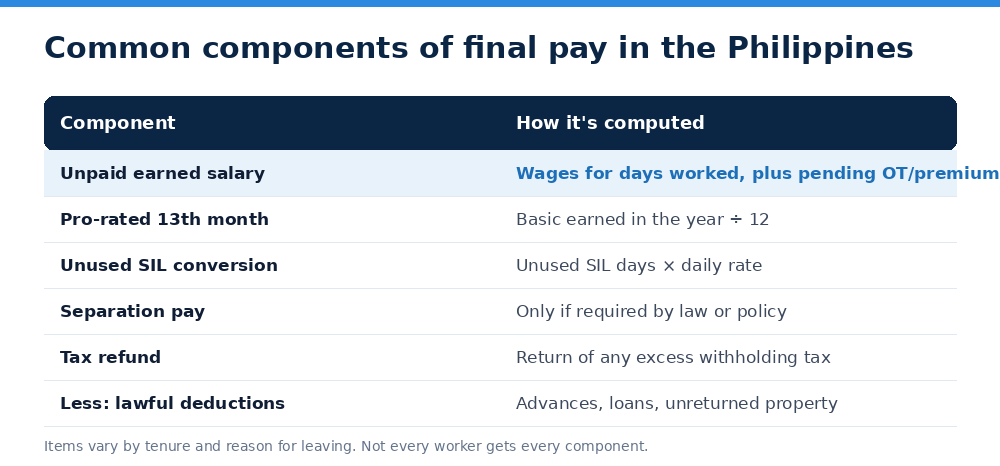
Final pay is a bundle, not a single figure. Depending on your situation and company policy, it can include several of the following:
- Unpaid earned salary — wages for days actually worked up to your last day, including any pending overtime, night differential, or holiday premiums.
- Pro-rated 13th month pay — your basic salary earned in the calendar year divided by 12. If you leave in July, you're entitled to the portion covering January through your last day, even though December is far off.
- Cash conversion of unused Service Incentive Leave (SIL) — employees with at least one year of service get 5 SIL days per year, and any unused days are convertible to cash. Company leave that's more generous than the statutory minimum follows the terms of your policy or CBA.
- Separation pay — only when required by law (for example, authorized-cause terminations like redundancy or retrenchment) or promised by contract or company policy. A plain resignation usually carries no separation pay.
- Tax refund — if too much withholding tax was deducted during the year, the excess is returned through your year-end or final tax adjustment.
- Other agreed amounts — unreleased commissions, pro-rated allowances, or the return of deposits, less any lawful deductions such as unliquidated cash advances, unreturned company property, or documented loans.
Not every worker gets every item. A first-year employee who resigns has no SIL to convert; a redundant employee does receive separation pay. Build the list from the person's actual circumstances.
When is final pay due? The 30-day rule
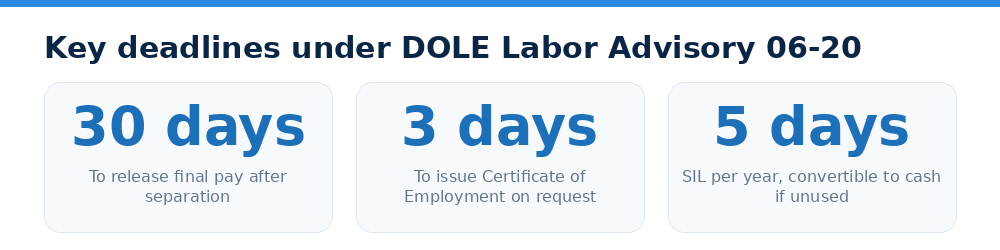
This is the part everyone wants nailed down. Under DOLE Labor Advisory No. 06, Series of 2020, final pay should generally be released within 30 days from the date of separation or termination, unless a shorter period is set by company policy, an individual contract, or a collective bargaining agreement.
The same advisory covers the Certificate of Employment (COE): employers must issue it within three (3) days of the employee's request. The COE is separate from final pay — an employer can't hold your COE hostage while clearance is pending, and you shouldn't have to wait for your last pay to get proof of your employment history.
Thirty days is the default, not a hard ceiling for every case. Genuinely complex settlements — multiple loans, unreturned assets, disputed deductions — can take longer, but the burden is on the employer to process in good faith. Sitting on someone's back pay without reason is not compliant, and unresolved cases can be brought to a DOLE Single Entry Approach (SEnA) conciliation.
A useful mindset for employers: treat the 30 days as a service-level commitment, not a countdown you're entitled to use in full. Many companies release final pay in two weeks or less simply because their clearance is organized. Setting a realistic timeline in the employee handbook — and actually meeting it — prevents most disputes before they start and keeps former staff speaking well of you.
From clearance to release: how the process works
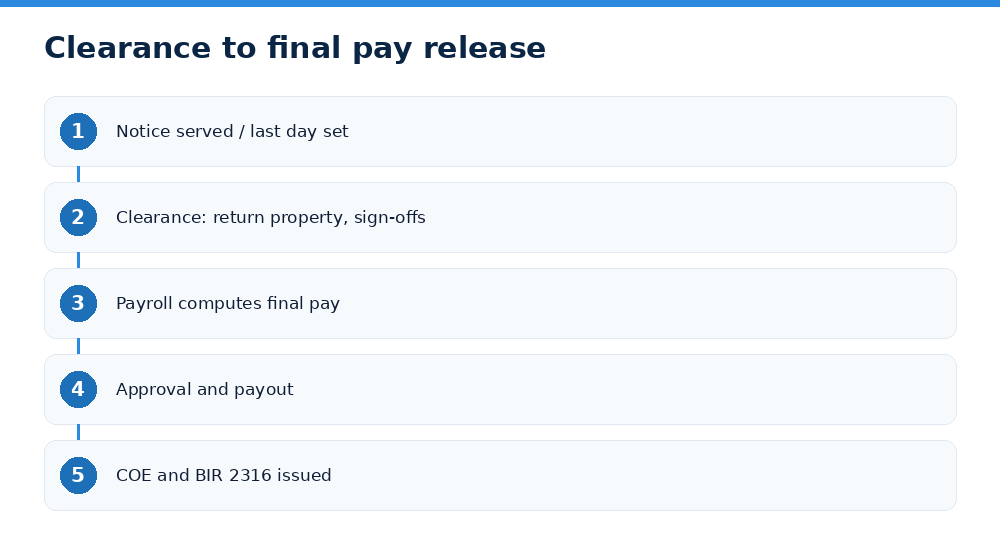
Final pay rarely lands the day you walk out, because most companies run a clearance first. Clearance is simply the process of confirming you've returned company property and settled any accountabilities so the final amount can be computed accurately. A typical flow looks like this:
- Notice and last day — resignation (ideally with the standard 30-day notice) or a termination notice sets your separation date.
- Clearance routing — you return the laptop, ID, and tools; HR, IT, Finance, and your manager sign off on any accountabilities.
- Computation — payroll totals your earned wages, pro-rated 13th month, unused SIL, and tax adjustment, then subtracts lawful deductions.
- Approval and release — the net final pay is approved and paid out, and your COE and BIR Form 2316 are issued.
Faster clearance means faster pay. Returning equipment promptly and settling advances early removes the most common bottlenecks on the employee's side.
A sample final pay computation
Let's make it concrete. Say Maria earns a PHP 30,000 monthly basic salary and resigns effective June 30, 2026. She has no cash advances and has used none of her 5 SIL days this year. Her daily rate (using a common 26-day factor) is roughly PHP 1,153.85.
- Unpaid salary for the final cutoff already worked: assume PHP 15,000 for the half-month still owed.
- Pro-rated 13th month: basic earned Jan–Jun = PHP 180,000 ÷ 12 = PHP 15,000.
- Unused SIL conversion: 5 days × PHP 1,153.85 = PHP 5,769.25.
- Tax refund: assume a PHP 1,200 over-withholding adjustment in her favor.
Adding these gives roughly PHP 36,969.25 before any deductions. Because her 13th month for the year stays well under the PHP 90,000 tax-exempt ceiling, that portion isn't taxed. If Maria had an outstanding cash advance of, say, PHP 3,000, that lawful deduction would be subtracted here, bringing the net down accordingly. Your real numbers will differ — the day-rate factor, cutoff, and deductions all depend on your policy — but the method holds: itemize every component, apply only lawful deductions, and hand the employee a clear breakdown so there are no surprises later.
What can delay final pay — and what to do
Most delays trace back to a handful of causes. Knowing them helps both sides avoid the wait:
- Incomplete clearance — unreturned laptops, IDs, or SIM cards stall computation. Return everything on or before your last day.
- Unsettled accountabilities — cash advances or loans that need liquidation. Reconcile these early so the net figure is clean.
- Disputed deductions — charges for alleged damage or shortages. These must be documented and lawful; blanket deductions without basis are not allowed.
- Slow internal routing — clearance forms stuck between departments. A defined offboarding checklist keeps things moving.
If 30 days pass with no valid reason and no pay, put your request in writing, keep a copy, and — if it's still unresolved — file for assistance at the nearest DOLE office through SEnA. Most cases settle at conciliation without a formal complaint.
Make offboarding painless with Sahodly
Final pay goes wrong when it's computed by hand under time pressure — a missed SIL conversion here, a wrong pro-rated 13th month there. Getting it right the first time protects your business and sends employees off on good terms.
Sahodly tracks salary, leave balances, and 13th month accruals as you go, so a departing employee's final pay is mostly computed before clearance even starts — with a clear breakdown you can hand over on the spot. Try Sahodly free and make your next offboarding a clean one.