Minimum Wage in the Philippines (2026): What Employers Must Know
Who Actually Sets the Minimum Wage in the Philippines
There is no single national minimum wage in the Philippines. Instead, each of the 17 Regional Tripartite Wages and Productivity Boards (RTWPBs) issues its own wage order under the guidance of the National Wages and Productivity Commission (NWPC) and the Department of Labor and Employment (DOLE). That means the legal minimum a worker in Metro Manila must be paid is different from the minimum in Cebu, Davao, or Central Luzon.
Within a single region, rates can also differ by sector (non-agriculture vs. agriculture) and by establishment size (for example, retail or service firms with a small number of workers often have a slightly lower floor). Boards review rates periodically, so the figure that was correct last year may already be outdated.
For employers, the practical takeaway is simple: your compliance obligation is tied to the latest wage order for the region where your employee actually works, not to a nationwide number. Always confirm the current order on the NWPC website (nwpc.dole.gov.ph) before finalizing payroll.
Wage orders also usually carry an exemption mechanism for distressed establishments and, sometimes, for barangay micro-business enterprises, but these must be applied for and approved — they are not automatic. Paying below the applicable minimum without an approved exemption exposes you to money claims, double-indemnity penalties under RA 8188, and possible DOLE inspection findings. Because the risk sits with the employer, it pays to treat every new wage order as a scheduled payroll event rather than something to react to after the fact.
NCR Rates in 2026: Wage Order NCR-27
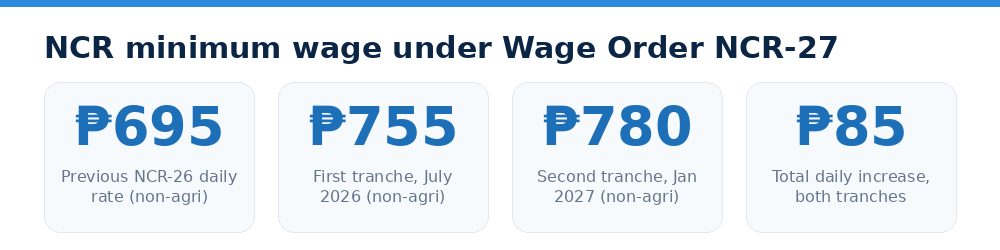
The headline change for 2026 is in the National Capital Region. Under Wage Order NCR-27, the RTWPB-NCR approved a two-tranche increase that raises the Metro Manila daily minimum from the previous NCR-26 level of ₱695 (non-agriculture).
- First tranche (effective July 2026): ₱755 per day for the non-agriculture sector, and ₱718 per day for agriculture, plus retail/service establishments with 15 or fewer workers and manufacturing firms with fewer than 10 workers.
- Second tranche (effective January 2027): ₱780 per day (non-agriculture) and ₱743 per day (the smaller-establishment/agriculture tier).
That is roughly an ₱85 total increase in the daily floor once both tranches are in effect. Exact effective dates were reported slightly differently across outlets as the order rolled out, so verify the precise date and figures on the official NCR-27 wage order before adjusting your payroll runs.
Sample Regional Daily Minimum Wages (2026)
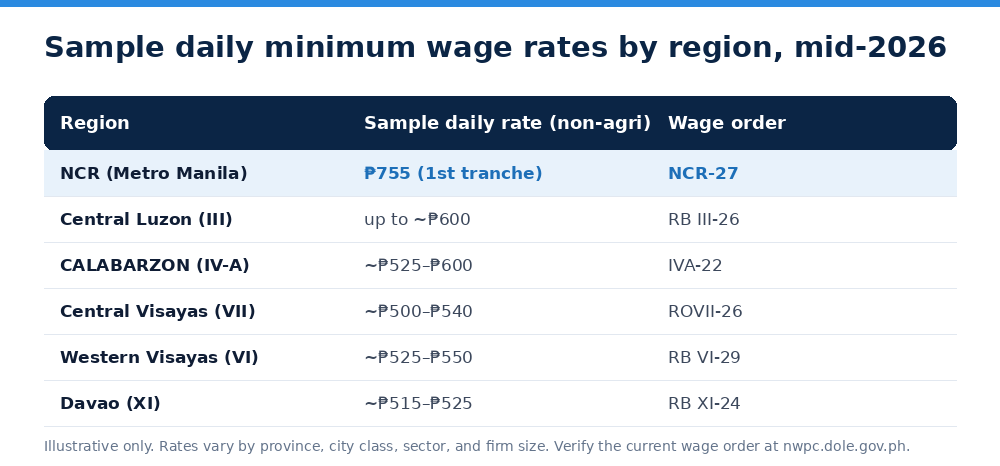
Because every region moves on its own schedule, here is a snapshot of sample daily minimum wage rates in mid-2026 to show the spread. Treat these as illustrative ranges, not the final word — rates within a region vary by province, city class, sector, and establishment size, and boards issue new orders throughout the year.
The figures below come from regional wage orders in effect around July 2026. Metro Manila sits at the top of the range, while several provincial regions cluster in the ₱500–₱600 band. Whatever region you operate in, pull the specific tier that matches your worksite from the current wage order.
A few things make regional comparison trickier than it looks. First, many regions publish multiple rates within one order — for example, a higher figure for cities in an expanded metro area and a lower one for lower-class municipalities. Second, some orders separate a basic wage from a cost-of-living allowance (COLA) that may still be in the process of being integrated into the basic rate. Third, agriculture and very small establishments almost always sit on a lower tier. So when someone quotes you a single peso number for a region, ask which tier it refers to. For a business with staff spread across provinces, that can mean maintaining several different minimums at once — one reason many employers automate the lookup instead of tracking it in a spreadsheet.
Minimum Wage Earners Are Exempt From Income Tax
One rule catches many new employers off guard: a statutory minimum wage earner (MWE) is exempt from income tax and from withholding tax on that income. This exemption was introduced by RA 9504 and is carried in the National Internal Revenue Code, and it survives the TRAIN Law framework.
Crucially, the exemption is not limited to the basic minimum wage itself. For a qualified MWE, the following are also exempt from income tax:
- Holiday pay (regular and special day premiums)
- Overtime pay
- Night shift differential
- Hazard pay, where applicable
So if you employ workers at exactly the regional minimum, you generally do not withhold income tax on their wages or on those statutory premiums. Note two caveats: mandatory SSS, PhilHealth, and Pag-IBIG contributions are still deducted (these are separate from income tax and are themselves non-taxable), and if an employee receives other taxable income or is paid above the minimum, MWE treatment may no longer apply. When in doubt, check the employee's status against the current BIR rules.
There is a subtle upside to a wage increase here. Because the exempt amount tracks the statutory minimum wage, when a wage order lifts the regional floor, the ceiling of tax-exempt minimum-wage income effectively rises with it. A worker who was an MWE before the increase and stays at the new minimum remains exempt on that higher wage. This is different from workers paid above the minimum, who fall under the regular TRAIN Law tax table — where the first ₱250,000 of annual taxable income is already tax-free, so many modestly paid, above-minimum employees still owe little or no income tax. The distinction matters mainly for your withholding setup and BIR reporting (such as the 1601-C and the year-end 2316), so it is worth classifying each employee correctly from the start.
The Ripple Effect: How a Wage Hike Touches the Rest of Payroll
Raising the daily rate is only the visible part of a minimum wage increase. Because so many pay items are calculated from the daily or hourly rate, a bump like NCR-27 quietly increases several other figures:
- Overtime: +25% of the (now higher) hourly rate on ordinary days.
- Night shift differential: +10% for work between 10:00 PM and 6:00 AM.
- Rest day and special day work: +30%; regular holidays pay 200% for the first 8 hours.
- 13th month pay: based on total basic salary earned in the year, so it rises too.
- SSS contributions: a higher salary can push an employee into a higher Monthly Salary Credit bracket, changing both employee and employer shares.
The KPI snapshot below summarizes the NCR-27 figures at a glance so you can see how the floor moved.
An Employer Compliance Checklist
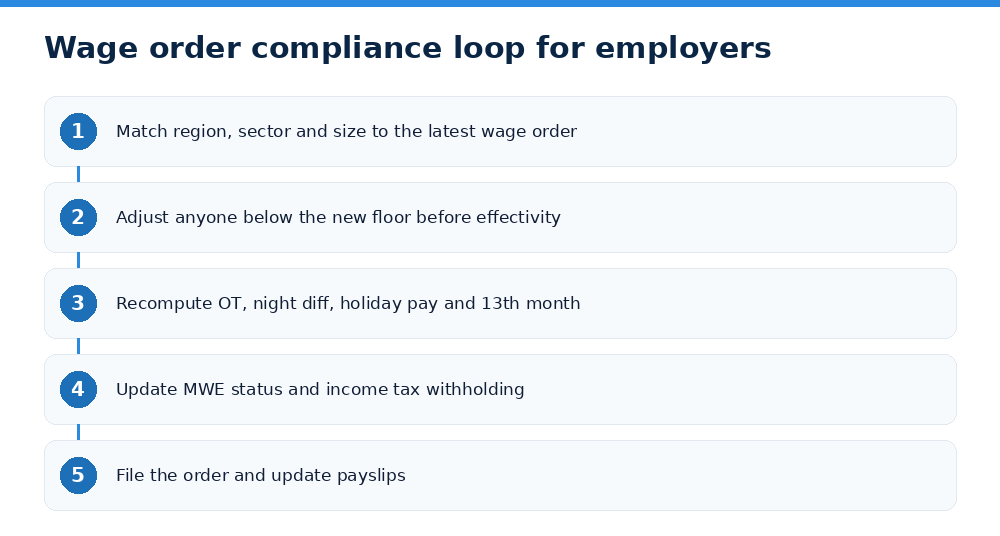
Staying compliant is mostly about process. Here is a practical loop to follow whenever a new wage order lands:
- Identify the correct order: match the region, sector, and establishment size of each worksite to the latest wage order.
- Compare against current pay: flag anyone earning below the new floor and adjust before the effectivity date.
- Recompute derived pay: update hourly rates, OT, night differential, holiday premiums, and 13th month accrual.
- Check MWE status: confirm who now qualifies as a minimum wage earner and stop or adjust income tax withholding accordingly.
- Post and document: keep the wage order on file and update payslips so the breakdown is transparent.
None of this is legal or tax advice, and edge cases (exemptions, wage distortion adjustments, above-minimum staff) can get technical — confirm with DOLE or the BIR for your specific situation. If you would rather not track this by hand, Sahodly keeps regional rates, statutory contributions, and MWE tax rules in one place. Try Sahodly free and let your payroll math update itself.