5 Payroll Mistakes Small PH Businesses Make (and How to Avoid Them)
Why small payroll errors cost more than you think
For a small business in the Philippines, payroll is one of the few tasks where a tiny slip can snowball into penalties, back-payments, and unhappy employees all at once. A wrong contribution rate, a missed remittance deadline, or a miscomputed holiday premium may look like loose change per payslip, but multiply it across your whole team and several months and the numbers add up fast.
The good news: most payroll mistakes in the Philippines come from a handful of recurring issues, and every one of them is avoidable once you know where to look. Below are the five we see most often among PH small-business owners and HR staff, along with practical, plain-English fixes for each. Rates cited here follow the 2026 government schedules; always confirm edge cases with the agency concerned.
Notice the pattern as you read: nearly all of these errors trace back to either an outdated figure or a manual step that nobody double-checked. Fix the source of truth and the process, and the mistakes largely take care of themselves. This is not legal or tax advice, just the practical checklist we wish every new employer had on day one.
Mistake 1: Using the wrong SSS, PhilHealth, and Pag-IBIG rates
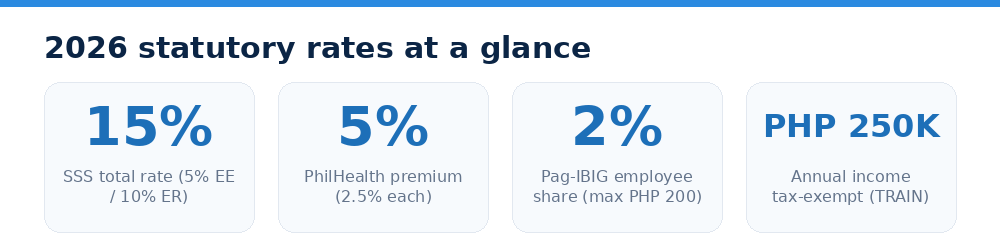
Mandatory contributions change more often than owners expect, and using last year's table, or worse, an outdated online calculator, is the single most common error we see. For 2026, here are the figures to lock in:
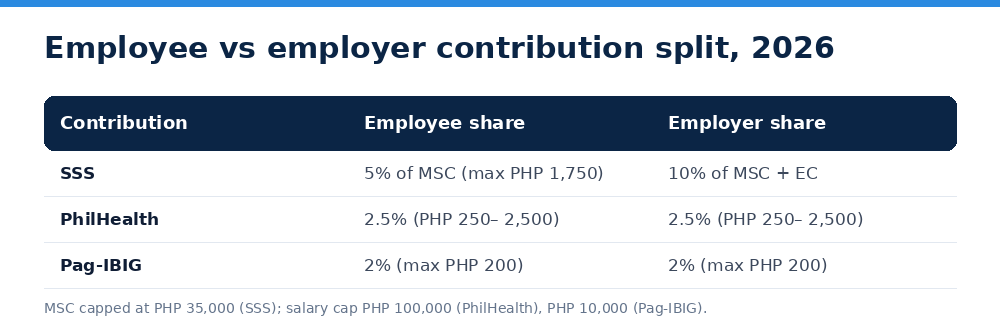
- SSS: total rate of 15% of the Monthly Salary Credit (MSC), split into 5% employee and 10% employer. The MSC floor is PHP 5,000 and the ceiling is PHP 35,000, so the maximum employee share is PHP 1,750 per month. The employer also shoulders a small Employees' Compensation (EC) premium of PHP 10 or PHP 30.
- PhilHealth: 5% of monthly basic salary, split equally at 2.5% each. The income floor is PHP 10,000 and the ceiling is PHP 100,000, meaning the employee share runs from PHP 250 up to PHP 2,500.
- Pag-IBIG: 2% employee and 2% employer for monthly pay above PHP 1,500, computed on a maximum of PHP 10,000, so the standard cap is PHP 200 each.
A common sub-error is applying a rate to the wrong base. SSS is computed on the Monthly Salary Credit bracket, not on raw gross pay, while PhilHealth uses monthly basic salary and Pag-IBIG uses monthly compensation up to its own cap. Mixing up these bases quietly under- or over-deducts every payslip, even when the percentages themselves are correct.
How to avoid it: keep one verified rate table as your single source of truth, and re-check the SSS, PhilHealth, and Pag-IBIG circulars every January. Never eyeball a percentage from memory, and confirm which salary base each contribution applies to. Software that updates the brackets automatically removes the guesswork entirely.
Mistake 2: Missing BIR withholding and remittance deadlines
Withholding tax trips up small businesses in two ways: computing it wrong, and remitting it late. On computation, remember that the TRAIN annual table exempts the first PHP 250,000 of taxable income, and that mandatory SSS, PhilHealth, and Pag-IBIG contributions are non-taxable, so you deduct them before applying the tax brackets. Skipping that step inflates the tax you withhold and shortchanges your staff.
On deadlines, the recurring compliance forms are easy to forget:
- 1601-C is the monthly remittance return for taxes withheld on compensation.
- 2316 is the annual certificate of tax withheld you issue to each employee (the basis for substituted filing).
- 1604-C is the annual information return, filed with the Alphalist.
These are separate from the expanded withholding forms, such as 0619-E, 1601-EQ, and 1604-E, which cover payments to suppliers and professionals rather than employee compensation. Filing a supplier form when you meant a compensation form, or vice versa, is a surprisingly frequent mix-up for owners handling both.
How to avoid it: put every filing date on a shared calendar with a reminder several days ahead, and reconcile what you withheld against what you remitted every single month. A late 1601-C draws surcharges and interest that dwarf the effort of filing on time, so treat these deadlines as non-negotiable.
Mistake 3: Getting overtime, night, and holiday premiums wrong
Premium pay rules under the Labor Code are precise, and rounding them off "close enough" is both a compliance risk and a morale killer. The core rates to apply on top of the ordinary hourly rate are:
- Overtime beyond 8 hours on an ordinary day: +25%.
- Night shift differential for work between 10:00 PM and 6:00 AM: +10%.
- Rest day or special non-working day worked: +30%.
- Regular holiday worked: 200% for the first 8 hours (and 100% even if unworked, subject to conditions).
- Overtime on a rest day or holiday: an additional +30% of the applicable hourly rate.
These stack, so a night-shift hour of overtime on a regular holiday is not a single flat figure, it is layered on the correct base rate. Getting the order wrong under- or over-pays staff.
How to avoid it: map each premium to the day type before you compute, and don't forget the Service Incentive Leave of 5 days per year after one year of service, which is convertible to cash if unused. When in doubt, compute the hourly rate first, then apply premiums step by step, and keep the official DOLE holiday list handy each year so special and regular days are never confused.
Mistake 4: Botching the 13th month pay
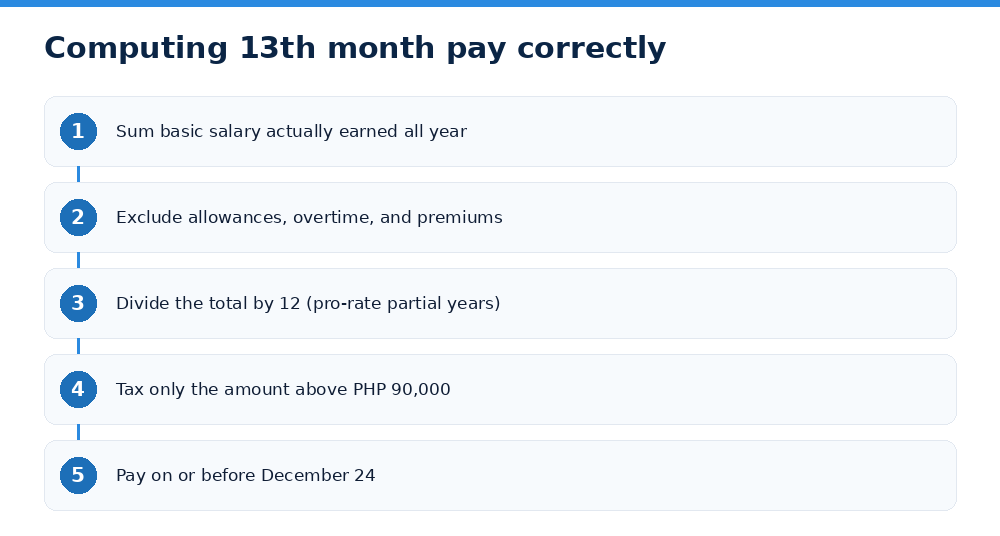
The 13th month pay is mandatory under PD 851 for rank-and-file employees who worked at least one month during the year, and it is due on or before December 24. Two errors dominate here. First, using the wrong formula: it is total basic salary actually earned in the calendar year divided by 12, not a full month's current salary, and not gross pay inflated by allowances or overtime. Employees who did not work the full year are pro-rated.
Second, mishandling the tax. The 13th month pay is tax-exempt up to PHP 90,000, a ceiling shared with other bonuses and benefits; only the excess is taxable. Owners who tax the whole amount, or forget to tax the excess, both end up filing wrong.
How to avoid it: track basic salary separately from allowances all year so the year-end computation is a simple division. Run a trial computation by November so December's cash-flow and any taxable excess hold no surprises.
Mistake 5: Running payroll on manual spreadsheets with no records
Many small businesses still run payroll on a spreadsheet that one person maintains from memory. It works until a formula breaks, a row is deleted, or that person goes on leave. Manual entry is where wrong rates, missed deductions, and untraceable errors quietly creep in, and there is often no clean audit trail when SSS, BIR, or an employee asks a question.
Closely related is failing to issue payslips. Employees are entitled to a clear breakdown of gross pay, each statutory deduction, tax withheld, and net pay. Without it, disputes are hard to resolve and your own records stay incomplete.
How to avoid it: standardize your process so every run produces a consistent payslip and a saved record, and separate the computation from the person doing it. Cloud payroll software keeps the rate tables current, generates payslips automatically, and leaves a trail you can hand to any agency. Sahodly handles PH statutory computations and payslips in one place, and there's a free plan you can try before you commit, an easy way to retire the fragile spreadsheet for good.